Traditional Base vs. Open-Graded Base vs. AirDrain: What Should Go Under My Artificial Grass?
When homeowners compare artificial grass products, most of the attention goes to what they can see: blade shape, colour, feel and pile height. However, the part you cannot see—the base beneath the turf—has just as much influence on how the finished installation drains, feels and performs over time.
There is no single base system that is best for every project. At Turf Team Landscaping, we consider the existing soil, intended use, drainage conditions, access, surrounding elevations and budget before recommending a system.
The three main options are:
- A traditional compacted aggregate base
- An open-graded aggregate base
- An AirDrain base system
Here is how they differ and where each one makes the most sense.
Option 1: Traditional Compacted Aggregate Base
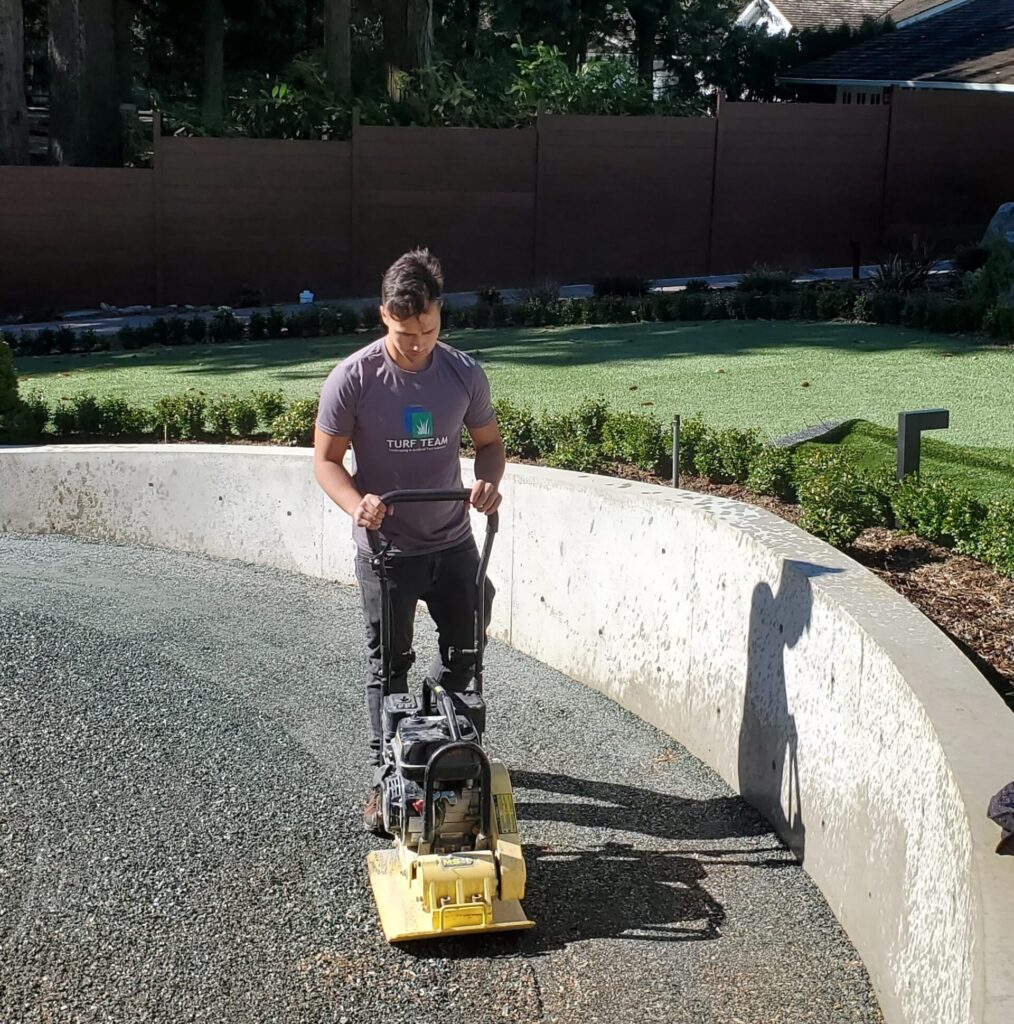
A traditional turf base is normally constructed using a dense-graded crushed aggregate such as road base or three-quarter-inch crush containing both stone and fines. The existing grass and soil are excavated, and the aggregate is installed and compacted in layers. A finer material called “crusher dust” is often used on top as a finished layer achieve the desired grade.
The smaller particles fill the spaces between the larger stones. Once properly compacted, this creates a dense, firm platform that is easy to grade and provides excellent support for a residential synthetic lawn.
Advantages of a Traditional Base
- Cost-effective: This is generally the most economical proven base system.
- Stable and firm: Dense-graded aggregate compacts tightly and provides strong support.
- Easy to fine-grade: It is well suited to smooth residential lawns, slopes and contours.
- Widely available: The materials and installation methods are familiar and readily available throughout the Lower Mainland.
- Suitable for most residential yards: When the site has positive drainage and a properly prepared subgrade, it offers a strong balance of price and performance.
Disadvantages of a Traditional Base
- Slower drainage through the base: The fines that make the material compact tightly also reduce its permeability.
- More dependent on surface grading: Water must be directed toward an appropriate outlet rather than simply being expected to disappear into the ground.
- Can retain moisture: This can be a concern over clay soil, in low areas or where the property already has drainage problems.
- Requires careful moisture control and compaction: Improper installation can lead to soft spots or settlement.
Best Applications
A traditional compacted base is normally a good choice for residential lawns with decent soil conditions, adequate slope and no history of major standing-water problems. It is often the best-value option when extreme drainage capacity is unnecessary.
Option 2: Open-Graded Aggregate Base (Great for Pets!)
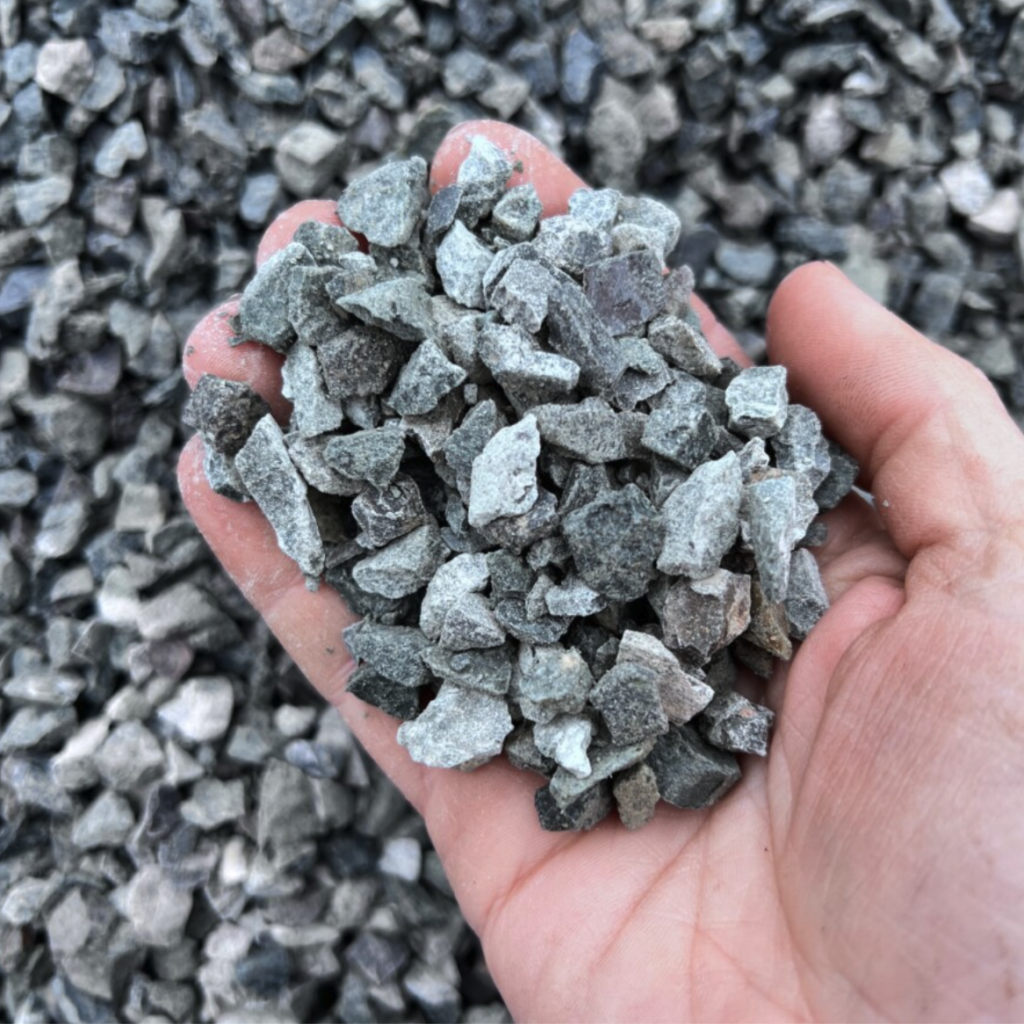
An open-graded base uses clean, angular crushed stone with few or no fine particles. Because the small particles are removed, connected voids remain between the stones, allowing water to travel vertically and laterally through the base.
A typical system may include larger clear crushed stone as the structural layer and a thinner layer of smaller clean chips on top for final grading. A geotextile separation fabric is often installed over the native soil to prevent soils from migrating into the clean stone and clogging its drainage spaces. However, for pet applications we do not recommend using fabric as it tends to absorb and hold odors.
Advantages of an Open-Graded Base
- Excellent permeability: Water (and pet urine) can move rapidly through the connected spaces in the aggregate.
- Reduced water retention: With few fines, the base stores less moisture through capillary action.
- Good freeze-thaw performance: Keeping water moving can reduce problems associated with saturated base material freezing and expanding.
- Strong structural interlock: Angular stone can form a stable base while retaining drainage voids.
- Useful for demanding sites: It is well suited to high-rainfall areas, pet applications, sports turf and properties with known drainage challenges.
Disadvantages of an Open-Graded Base
- Higher material and installation cost: Clean, specifically graded aggregates generally cost more than conventional road base.
- More difficult to fine-grade: Larger clean stone does not produce the same smooth surface as compacted material containing fines, so a compatible finishing course is important.
- Requires separation and more difficult to secure turf: Soil contamination and poorly restrained edges can compromise performance. Securing the turf perimeter is also more challenging as the nails will not hold as well in open-graded base.
- Still needs somewhere to drain: A permeable base is not a magic solution if the native soil is impermeable and there is no outlet. Depending on the site, perimeter drains or another discharge strategy may still be required.
Best Applications
Open-graded bases are a strong choice for pet systems, sports turf, high-rainfall locations and yards with slow-draining soils—provided the drainage system has a suitable outlet. They can also be valuable where long-term drainage performance justifies a higher upfront investment.
Option 3: AirDrain Base System (Great for Pets!)
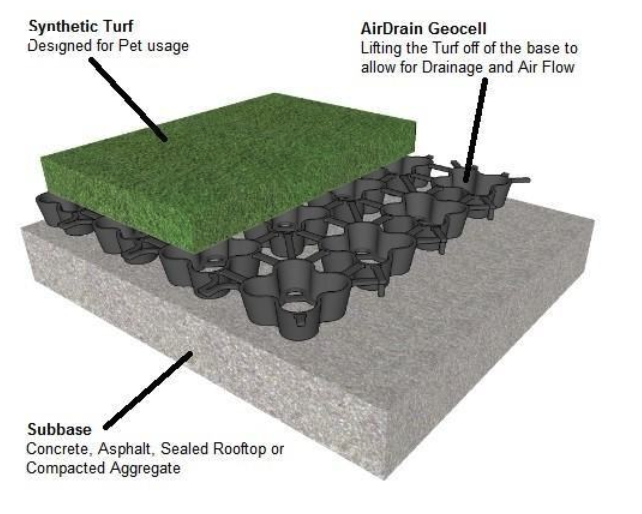
AirDrain is an engineered, interlocking drainage grid installed directly below the artificial turf and above a prepared subbase, concrete slab, asphalt surface or other approved assembly. The grid structure creates an open air space beneath the turf, allowing water to pass vertically through the turf and then move laterally toward drains or perimeter outlets. Unlike an aggregate-only system, AirDrain creates a defined drainage cavity across the installation.
Advantages of AirDrain
- High drainage capacity: The grid provides open vertical and lateral pathways beneath the turf.
- Ideal over hard surfaces: It can make artificial turf practical over concrete, asphalt, rooftops and other surfaces where water cannot infiltrate downward.
- Predictable drainage layer: Water is directed through a consistent void rather than relying only on the permeability of compacted aggregate.
- Reduced excavation in some applications: On a suitable existing surface, it may avoid the depth of aggregate normally required.
- Added separation from the subbase: Raising the turf above the underlying surface can help it clear water quickly when properly connected to an outlet.
- Potential for reuse: The panels may remain usable when the turf is eventually replaced, depending on their condition and the project assembly.
Disadvantages of AirDrain
- Highest upfront cost: The grid, fabric, edge details and installation add cost compared with aggregate alone.
- Requires careful detailing: Panel layout, fabric, seams, edges, transitions and outlet locations all need to work together.
- Does not eliminate the need for a prepared subbase: AirDrain must still be installed over a stable, correctly graded supporting surface.
- The outlet remains critical: The system can move a large volume of water, but that water still needs a properly designed place to go.
- Not necessary for every lawn: A standard residential yard with good grading may receive little practical benefit from the additional investment.
Best Applications
AirDrain is most valuable for rooftop turf, concrete patios, converted courts, commercial pet areas, playgrounds, sports fields and properties where a high-capacity, defined drainage layer is required. It may also be appropriate when excavation is restricted or the existing surface needs to remain in place.
Quick Comparison
| Feature | Traditional compacted base | Open-graded base | AirDrain system |
|---|---|---|---|
| Typical cost | Lowest | Medium to high | Highest |
| Drainage through system | Moderate | High | Very high when connected to an adequate outlet |
| Surface grading | Relatively straightforward | Requires a suitable finishing course | Supporting surface must already be properly prepared |
| Stability | Excellent when compacted correctly | Excellent when correctly specified and confined | Excellent when correctly installed |
| Best value for | Typical residential lawns | Wet sites, poor drainage areas and pet applications | Hard surfaces, rooftops and pet applications |
| Primary limitation | Fines restrict permeability | Needs separation, confinement and an outlet | Cost and more complex detailing |
Which Base Is Best for Your Artificial Grass?
For many residential projects, a traditional compacted aggregate base remains the most practical and cost-effective choice. It creates a firm, smooth surface and performs reliably when the yard is properly graded.
An open-graded base is a worthwhile upgrade when drainage, saturated soil or freeze-thaw performance is a greater concern. It offers substantially more space for water to move, but the system must be protected from soil contamination and connected to an effective drainage plan.
AirDrain is the most specialized option. It is particularly useful over concrete, asphalt, rooftops and other installations where water needs a dedicated path beneath the turf. Its added cost makes the most sense when the site conditions allow its drainage capacity and construction advantages to provide a meaningful benefit.
Get a Base System Designed for Your Property
Turf Team Landscaping designs artificial grass installations for the realities of the Lower Mainland: heavy rainfall, clay soil, difficult access and properties where drainage cannot be treated as an afterthought.
Before recommending a base, we look at how water currently moves across the property, what lies beneath the proposed turf, how the area will be used and where the water can safely discharge. That allows us to recommend a system that fits the site rather than automatically selling the most expensive option.
If you are planning an artificial grass installation in Vancouver or the Lower Mainland, contact Turf Team Landscaping to arrange a consultation and receive a recommendation for your property!